A client came to me with a beautiful UI. They’d built it in Figma Make, the AI-powered prototyping tool. The app looked stunning, animations were smooth. Just one problem: I couldn’t get to the actual code. Normally you can use the api or export design files, but not with Make. The Figma API Returns {"status":400,"err":"File type not supported by this endpoint"} for Make files.
Why would you not be able to do that? The wonders of corporate lock-in, I suppose.
That’s a problem: no design file. What now? So on to searching for ways to extract the code.
Update - January 29, 2026
A few useful tips from readers:
- Use the
filecommand first: Before reaching forxxd, runningfile ClientApp.makewould have identified it as a ZIP archive immediately. Good reminder to start with the obvious tools. - Try
binwalkfor unknown binaries: It scans for known file signatures and can identify embedded files within a single binary. Worth trying early in the process.
Now let’s get into it.
The Discovery: It’s Just a ZIP File
So I started clicking around the Figma interface, looking for anything useful. That’s when I noticed you can download the .make file itself. Download. A file, interesting!
But I can not read it. Hmmm, what now? Rule number one: never trust the extension. A .make file could be anything. After a while I figured out it was a ZIP file. And in it was in essence a React application.

The Discovery: It’s Just a ZIP File
First thing I did was look at the raw bytes:
xxd -l 4 "ClientApp.make"
# Output: 504b 0304
504b is PK in ASCII. That’s the ZIP file signature. The whole mysterious .make file is just a ZIP archive with a different extension. Learned something new today (about 504b).
Unzip it:
ClientApp.make (ZIP)
├── canvas.fig          # 2.3 MB binary - the interesting part
├── meta.json           # Project metadata
├── ai_chat.json        # 34 MB of AI conversation history
├── thumbnail.png       # Preview image
├── images/             # 110 image assets (hash-named, no extensions)
└── blob_store/         # Additional binary data
The ai_chat.json was massive. Every prompt, every response, every iteration the client went through while building the app. Not very useful, and not what I needed. (although i did try to extract design tokens from it at first, before turning to the binary file).
The canvas.fig file held the actual code. 2.3 MB of binary data. That extension sounds more like a standard Figma design file. How to read that and see if it contains anything useful? Time to dig deeper.
Decoding the Binary Format
Looking at the header:
xxd -l 20 canvas.fig
# Output: 6669 672d 6d61 6b65 65... (fig-makee)
Standard Figma design files use fig-kiwi as their magic header. Make files use fig-makee. Different format, same general approach.
The structure:
| Offset | Size | Content |
|---|---|---|
| 0 | 9 bytes | Magic: fig-makee |
| 9 | 3 bytes | Padding |
| 12 | 4 bytes | Chunk 1 size (little-endian) |
| 16 | N bytes | Chunk 1 data |
| 16+N | 4 bytes | Chunk 2 size |
| 20+N | M bytes | Chunk 2 data |
Two chunks. Two different compression algorithms. Thanks for some AI help here, LLMs are great at spotting patterns in binary data.
The Compression Puzzle
First attempt: zlib decompression on both chunks.
Error: Invalid stored block lengths
The first chunk decompressed fine with zlib/deflate. The second chunk refused. Checking its magic bytes: 28 B5 2F FD. That’s Zstandard compression. Different algorithm entirely.
So:
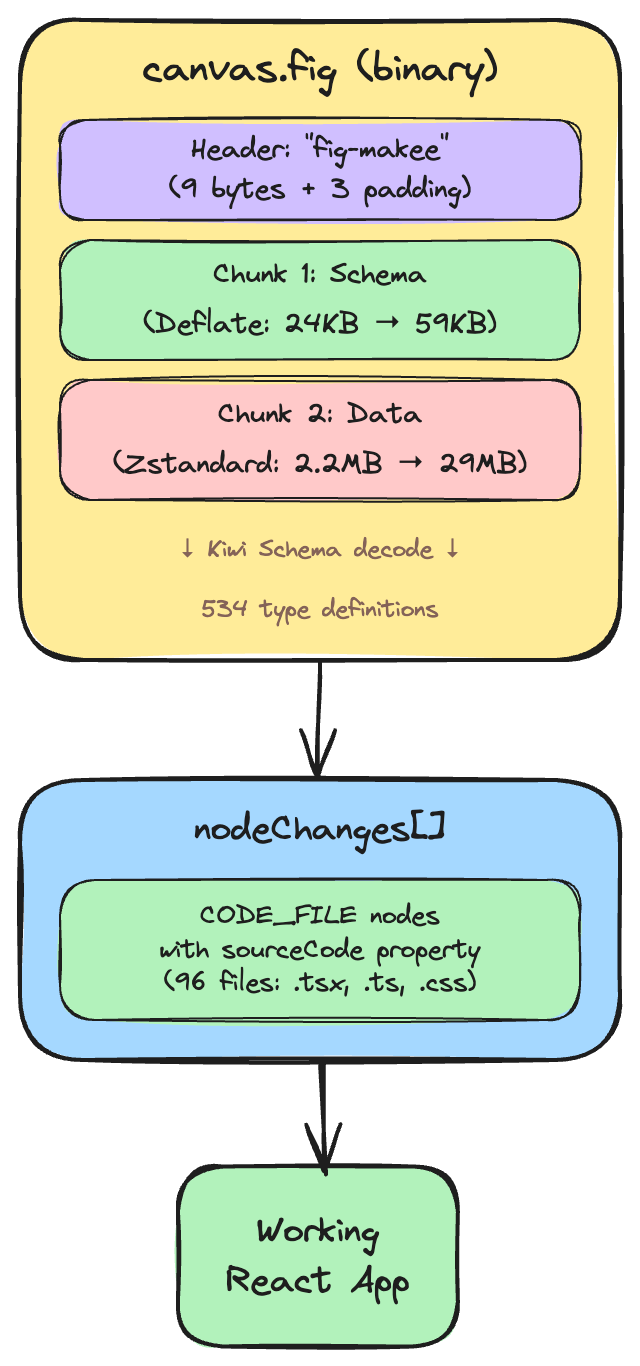
- Chunk 1 (Schema): Deflate compressed, 24KB → 59KB decompressed
- Chunk 2 (Data): Zstandard compressed, 2.2MB → 29MB decompressed
Three npm packages made this work: pako for deflate, fzstd for Zstandard, and kiwi-schema for decoding the binary data format. Again, LLMs to the rescue. I know a bit about compression, but this would have taken me a lot of time to figure out alone. And probably would have given up (rewards vs time invested).
Kiwi Schema: Figma’s Binary Format
Figma uses the Kiwi binary schema format. It’s compact but has no schema definition included. Fortunately, Chunk 1 contains exactly that: the schema.
The schema had 534 type definitions. Nodes, colors, vectors, transforms, fonts, and the one I cared about: CODE_FILE.
Decoding the message data revealed a tree structure with 159 nodes:
{
  "nodeChanges": [
    {
      "type": "DOCUMENT",
      "children": [...]
    },
    {
      "type": "CODE_FILE",
      "name": "App.tsx",
      "sourceCode": "import React from 'react'..."
    },
    // ... 157 more nodes
  ]
}
Every React component, utility function and CSS file were there in the sourceCode property. Progress! Now how to get to the content, the actual files?
Extracting the Content
Finding CODE_FILE nodes with source code was straightforward:
const codeFiles = nodeChanges.filter(
  node => node.type === 'CODE_FILE' && node.sourceCode
);
96 source files extracted:
- React components (
.tsx) - TypeScript utilities (
.ts) - CSS files including
globals.css - Data files
- React hooks
But having files isn’t the same as having a working app. Now to piece it all together, in a working structure:
From Files to Running App
The extracted code had some quirks:
Versioned package imports: Figma Make embeds version numbers directly in import statements.
// What Figma Make generates
import { Dialog } from '@radix-ui/react-dialog@1.1.6'

// What actually works
import { Dialog } from '@radix-ui/react-dialog'
Custom asset imports: Images use a proprietary format.
// What Figma Make generates
import heroImage from 'figma:asset/a1b2c3d4.png'

// What actually works
const heroImage = '/images/a1b2c3d4.png'
Missing file extensions: All images in the images/ folder were hash-named with no extensions. The browser needs .png to serve them correctly.
Tailwind CSS v4 changes: The PostCSS integration changed between versions. Needed @tailwindcss/postcss instead of using tailwindcss directly.
React StrictMode breaking animations: The original code used Framer Motion. StrictMode double-mounts components, which breaks timers and animations. Removing StrictMode fixed it.
I wrote scripts to handle all of this automatically. Analyze imports, determine folder structure (based on import references in the files), fix paths, copy images with proper extensions, generate package.json, Vite config, and TypeScript config.
The Result
cd make_extraction
./run-all.sh ../ClientApp.make
cd output/react_app
npm install --legacy-peer-deps
npm run dev
A working React application on localhost:5173. Same components, same styling, same animations. No manual conversion work. No information lost.
Design Token Extraction
Beyond source code, I also extracted design tokens using regex patterns:
- Hex colors:
#1a1a1a,#ffffff - RGBA values:
rgba(0, 0, 0, 0.5) - HSL colors:
hsl(220, 14%, 96%) - CSS variables:
--primary-color: #3b82f6 - Google Fonts:
Inter,Roboto
All exported to design-tokens.json for easy reference or migration to a design system.
Lessons Learned
Don’t assume compression types: The same file can use multiple compression algorithms for different chunks. Check the magic bytes.
Figma’s internal format is consistent: Whether it’s a design file or a code project, the underlying structure uses Kiwi schemas. Different content, same parsing approach.
React StrictMode has side effects: It’s great for catching bugs during development, but it can break production code that relies on mount/unmount timing.
The original code is usually correct: I wasted time “fixing” fonts that weren’t broken. The extraction was accurate; my assumptions weren’t.
And most interesting: Figma Make is a great tool, but under the hood it is straightforward React with Radix UI and Tailwind CSS. No magic, just well-structured code generation. (and i have to give it to them, the code quality is pretty good for AI-generated code!).
So after spending 3 hours reverse-engineering and an hour writing this post, I can now finally get to work on the actual app :-) Have a great day!
Get the Code
The extraction scripts are available here:
Repository: github.com/albertsikkema/figma-make-extractor
Quick start:
git clone https://github.com/albertsikkema/figma-make-extractor.git
cd figma-make-extractor/make_extraction
./run-all.sh ../YourApp.make
cd output/react_app
npm install --legacy-peer-deps
npm run dev
The scripts handle:
- Unzipping the
.makearchive - Decoding the
canvas.figbinary - Extracting source files
- Extracting design tokens
- Creating a runnable React/Vite project
When Would You Need This?
- Client hands you a Figma Make prototype but not the design file
- You want to audit AI-generated code before deployment
- You need to migrate away from Figma Make to a different stack
- You want to extract design tokens for your design system
- Pure curiosity about how Figma structures its data
Resources
CLI Tools for Binary Analysis:
- file - Identify file types from magic bytes
- binwalk - Scan for embedded files and compression signatures
Binary Format Analysis:
npm Packages Used:
- pako - Deflate compression
- fzstd - Zstandard for JavaScript
- kiwi-schema - Kiwi binary format decoder
Have a Figma Make file you can’t crack? Questions about the binary format? Get in touch or open an issue on GitHub.